Home & carHow-to
Turn Off Smart TV ACR Tracking: Samsung, LG, Vizio, Roku
What smart TV ACR tracking collects and why, plus exact settings-menu steps to turn it off on Samsung, LG, Vizio, and Roku TVs.
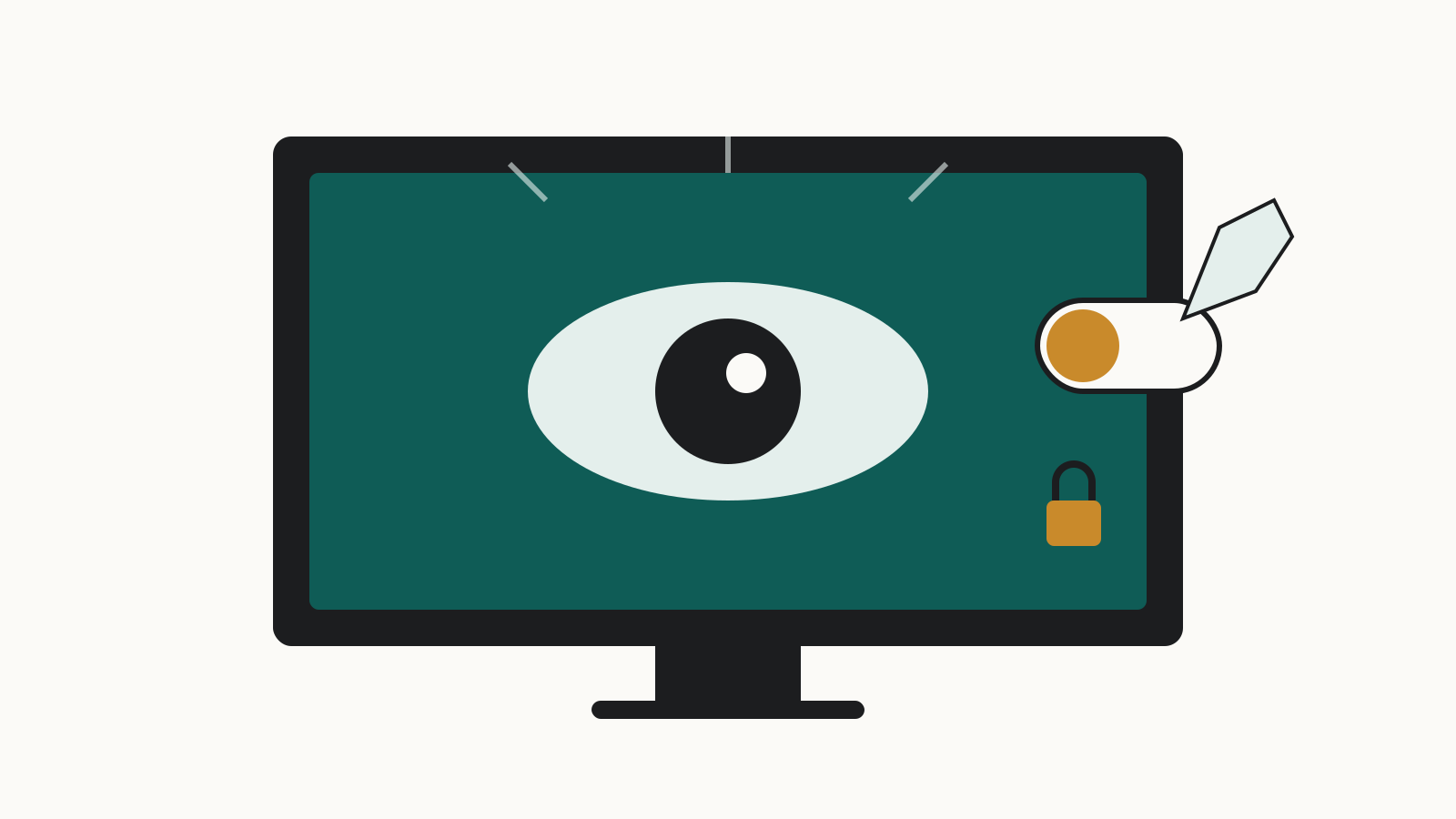
If you've ever wondered how to turn off ACR on a Samsung TV, or on whatever brand sits under your television, the short answer is: it's in your settings menu, usually a few taps away, and it's worth doing. Automatic content recognition, or ACR, is software built into many smart TVs that identifies what's on your screen and reports it back to the manufacturer. Here's what it collects, why regulators have already gone after one major TV maker over it, and exact steps to switch it off on the biggest brands.
What is ACR (automatic content recognition) on a smart TV?
ACR is built to identify every show you watch, no matter where it comes from. Consumer Reports' guide to smart TV snooping features describes it as technology that "attempts to identify every show you watch—including programs and movies you get via cable, over-the-air broadcasts, streaming services, and even Blu-ray discs." It doesn't matter whether the picture came from your cable box, a streaming app, an HDMI-connected game console, or a disc player. If it shows up on the screen, ACR can try to fingerprint it.
Samsung calls its version "Viewing Information Services." According to Samsung's support documentation, the feature only runs when a customer opts into Viewing Information Services during setup, at which point ACR generates unique signatures that capture information about what's being watched on the TV. Samsung also says on that same page that it does not record or watch the actual content displayed on the screen — it's matching signatures, not storing video of your living room.
On LG TVs, this happens through a feature called Live Plus. Tom's Guide reports that Live Plus analyzes on-screen pixels and audio cues to identify what's playing, including content coming from external devices like a cable box or a game console, not just built-in streaming apps.
Why do TV makers use ACR and who gets the data?
The stated purpose is better recommendations. But recommendations aren't the main business driver. As Consumer Reports puts it, "ACR, which goes by various names, can help your TV recommend shows to you. But the data can also be used for targeting ads to you and your family, and for other purposes."
That "other purposes" phrase has a concrete history. In 2017, the Federal Trade Commission and the New Jersey Attorney General's office settled charges against Vizio for exactly this kind of data collection. The FTC's official announcement states that Vizio "has agreed to pay $2.2 million to settle charges by the Federal Trade Commission and the Office of the New Jersey Attorney General that it installed software on its TVs to collect viewing data on 11 million consumer TVs without consumers' knowledge or consent."
It wasn't just viewing history. Regulators alleged Vizio combined that data with personal details and sold the result to outside companies. According to the same FTC release, Vizio helped append demographic details — including sex, age, income, marital status, household size, education level, home ownership, and household value — to the viewing data it collected, then sold that combined information to third parties who used it for purposes including cross-device targeted advertising.
The FTC also said Vizio had marketed the tracking as something else entirely. The agency's complaint alleged that Vizio promoted a "Smart Interactivity" feature as something that offered program suggestions, while not disclosing that turning it on also switched on the collection of viewing data, per the FTC's press release.
Today the major brands present ACR as an opt-in at setup with a toggle buried in settings afterwards — which is why the steps below exist at all. Consumer Reports notes that Vizio drew scrutiny from federal and state regulators in 2017 over collecting this kind of data without people's knowledge or consent.
How do I turn off ACR on a Samsung TV?
Samsung says the choice has always been yours. Its support page states that customers have always had, and continue to have, the right to opt out of ACR and the collection of viewing history at any time, simply by going into the Settings menu and adjusting preferences, according to Samsung's own support answer, which applies to "all Smart TVs manufactured by Samsung."
On newer Samsung sets, Consumer Reports lays out the specific path: "click the Home button on the TV's remote and go to Menu > Settings > All Settings. Scroll down and click on General & Privacy > Terms & Privacy, where you'll see both Smart Hub US Privacy Notice and Viewing Information, and Interest-Based Advertising." Turn off both Viewing Information and Interest-Based Advertising to disable ACR and stop ad targeting tied to it.
How do I turn off ACR (Live Plus) on an LG TV?
LG's ACR lives inside Live Plus. Tom's Guide describes the path as: "Navigate to System, then Additional Settings, locate Live Plus, and toggle it OFF. This immediately stops the TV from analyzing on-screen video frame-by-frame." The full menu route is Settings > All Settings > General > System > Additional Settings.
Consumer Reports describes a slightly different route depending on software version: "You can turn off LG's ACR by clicking on Viewing Information. The technology powers LG's Live Plus feature, which makes program recommendations based on what you watch and listen to on your TV." That path runs through Settings > All Settings > Support > Privacy & Terms > User Agreements.
LG told Tom's Guide that ACR, Voice Recognition and Interest-Based Advertising are all opt-in features, and that when a customer doesn't consent to the relevant agreement, ACR data collected isn't used for advertising.
How do I turn off ACR on a Vizio or Roku TV?
During setup, Vizio shows a screen for its ACR feature, called Viewing Data. Consumer Reports explains: "If you accept, you'll see options for Viewing Data, which is Vizio's ACR technology. Vizio explains how it is used and offers the option to decline it, view the policy, or accept it." After setup, you can still change your mind. Vizio's privacy controls sit under Settings > All Settings > Admin & Privacy on newer TVs, or under System > Reset & Admin on older models, according to the same Consumer Reports guide.
For Roku, Consumer Reports found the toggle under Settings > Privacy: "Smart TV Experience is where the ACR technology resides. Click on that option, and you can uncheck Use Info from TV Inputs, which will disable the TV's ACR technology."
Hisense TVs don't have one universal menu path worth memorizing, because different Hisense models run entirely different software. Consumer Reports notes that several TV brands, Hisense among them, run on either Amazon's Fire TV Edition or Google TV/Android TV platforms rather than a single manufacturer-built interface. If you own one, look for privacy or ad-personalization settings under whichever platform your set actually runs, since the labels won't match a generic "Hisense" menu.
Can I stop all smart TV data collection, or only ACR?
Turning off ACR stops content fingerprinting, but it doesn't unplug your TV from the internet or stop every kind of data flow. Consumer Reports is direct about this limit: "You can't stop all data collection without disconnecting your TV set from the internet, but you can turn off ACR on many models."
Tom's Guide makes a similar point specifically about LG sets, noting that disabling Live Plus doesn't stop the TV's local-network scanning. A full stop requires isolating the TV on a separate network or cutting it off from Wi-Fi altogether: "To prevent the TV from communicating with other devices on your Wi-Fi, open your router's companion app and assign your LG TV to an isolated Guest Network. Alternatively, disconnect the TV from Wi-Fi entirely and use a dedicated streaming device (like an Apple TV or Roku), which offers far tighter, transparent privacy controls."
Use this checklist to lock things down as far as you're willing to go:
- Samsung: Menu > Settings > All Settings > General & Privacy > Terms & Privacy — turn off Viewing Information and Interest-Based Advertising, per Samsung's support page.
- LG: Settings > All Settings > General > System > Additional Settings — toggle Live Plus off, per Tom's Guide (or try Support > Privacy & Terms > User Agreements > Viewing Information if that path isn't visible, per Consumer Reports).
- Vizio: Settings > All Settings > Admin & Privacy (or System > Reset & Admin on older sets) — turn off Viewing Data, per Consumer Reports.
- Roku: Settings > Privacy > Smart TV Experience — uncheck "Use Info from TV Inputs," per Consumer Reports.
- Hisense, Sony, TCL, Philips: check whether your set runs Fire TV Edition or Google/Android TV, then look for privacy or ad-personalization settings under that platform rather than a manufacturer-branded menu, per Consumer Reports.
- Reset your advertising ID periodically. Consumer Reports notes this is an added step beyond ACR: "You can also reset something called the advertiser ID, which companies use to compile information on you. Changing the ID periodically can reduce tracking."
- For a harder stop: put the TV on an isolated guest Wi-Fi network, or disconnect it from the internet entirely and watch everything through a separate streaming device instead, per Tom's Guide's recommendation.
Menu wording changes as manufacturers push firmware updates, so if a label doesn't match exactly what's on your screen, look nearby — "Privacy," "Terms," and "Admin" sections are the usual hiding spots for these toggles.
Sources
- Consumer Reports' guide to smart TV snooping features consumerreports.org
- Samsung's support documentation samsung.com
- Tom's Guide reports tomsguide.com
- FTC's official announcement ftc.gov